> For the complete documentation index, see [llms.txt](https://surf-2.gitbook.io/surfliquid-docs/llms.txt). Markdown versions of documentation pages are available by appending `.md` to page URLs; this page is available as [Markdown](https://surf-2.gitbook.io/surfliquid-docs/usdsurf-token/xp-and-reward-distribution.md).
# XP and Reward Distribution
Surf Leagues uses XP as the core accounting unit for contribution, reputation, and reward allocation.
XP is not a token. It is a non-transferable on-chain score that measures how much value a user creates for the ecosystem over time.
XP determines:
* Leaderboard rank
* Share of season rewards
* Access to advanced vaults and vault products
* Weighting in future governance and participation rights
This separates participation from speculation and ensures rewards flow to behaviour, not just balance.
***
### **XP Sources**
XP is earned from real economic activity:
#### **1. Capital Deployment**
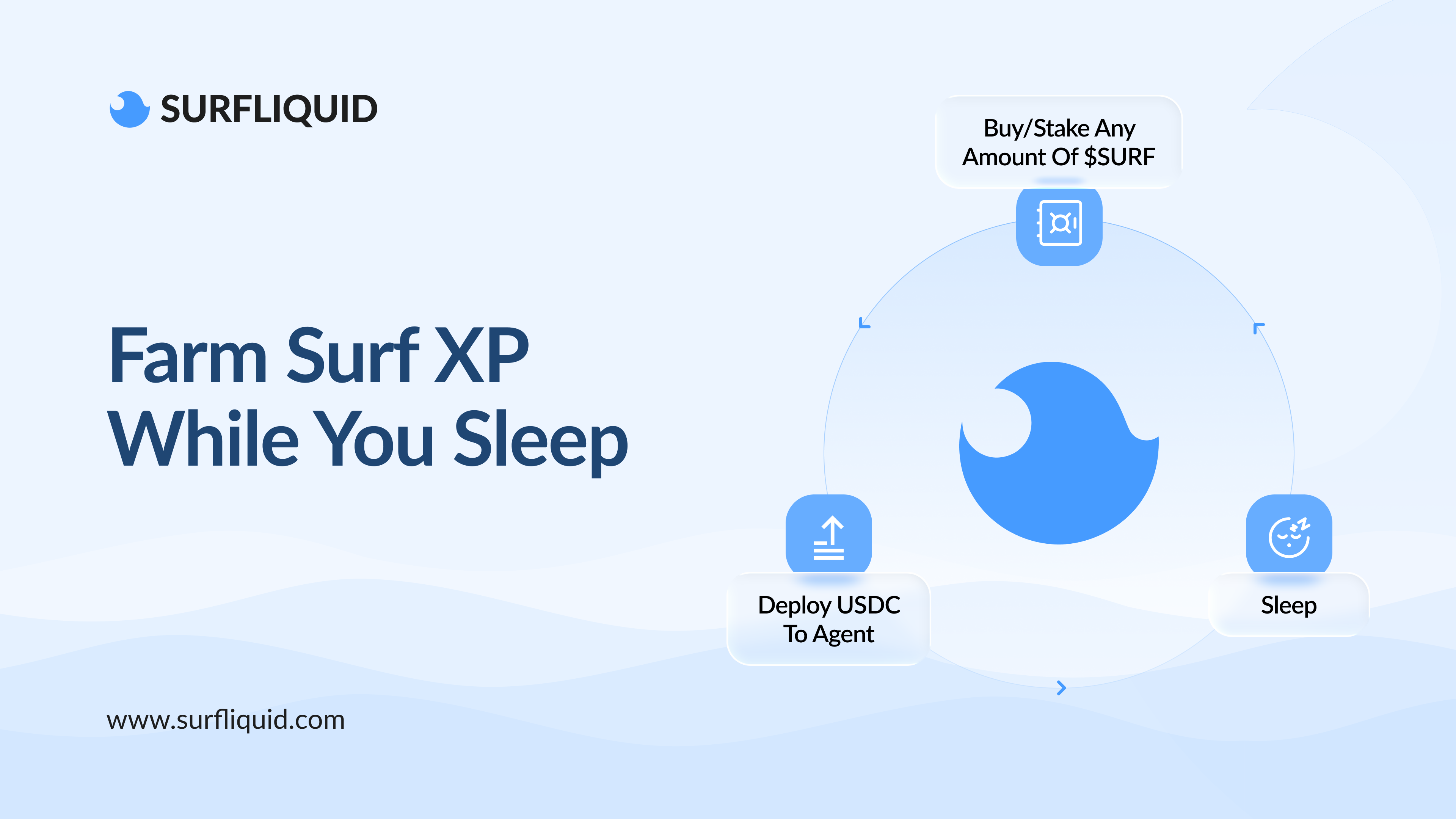
Depositing assets into Surf vaults generates continuous daily XP.
XP scales with:
* Amount deployed
* Time deployed
* Vault type and risk class
#### **2. Staking**
Staking $SURF generates daily XP.
This aligns long-term protocol participants with growth and stability.
#### **3. Trading Activity**
Trading $SURF on supported venues generates XP based on on-chain volume.
This rewards liquidity provision and market participation.
#### 4. Referrals
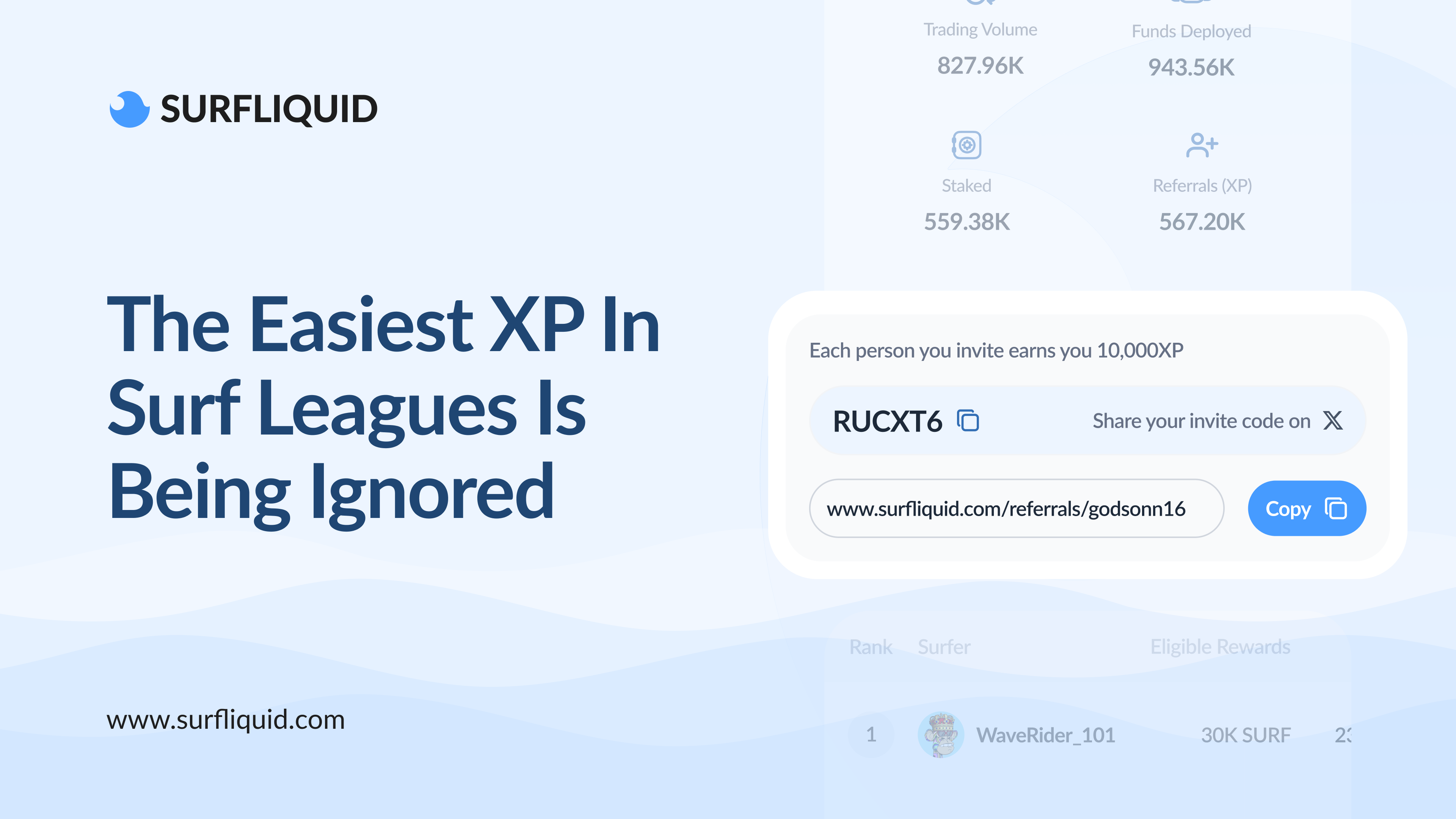
Direct referrals earn an instant XP bonus on activation.
Ongoing network activity generates a passive XP stream via second-order rewards, creating a compounding growth loop.
#### 5. Ecosystem Participation
Future sources will include:
* Vault creation
* Governance participation
* Liquidity routing
* Institutional and partner integrations
All XP is tracked automatically. No forms, no manual claims.
***
### **Multipliers**
XP weighting adjusts based on contribution quality and alignment:
* **Vault class multipliers**
Advanced and higher-capacity vaults generate higher XP per dollar than base vaults.
* **Season participation multipliers**
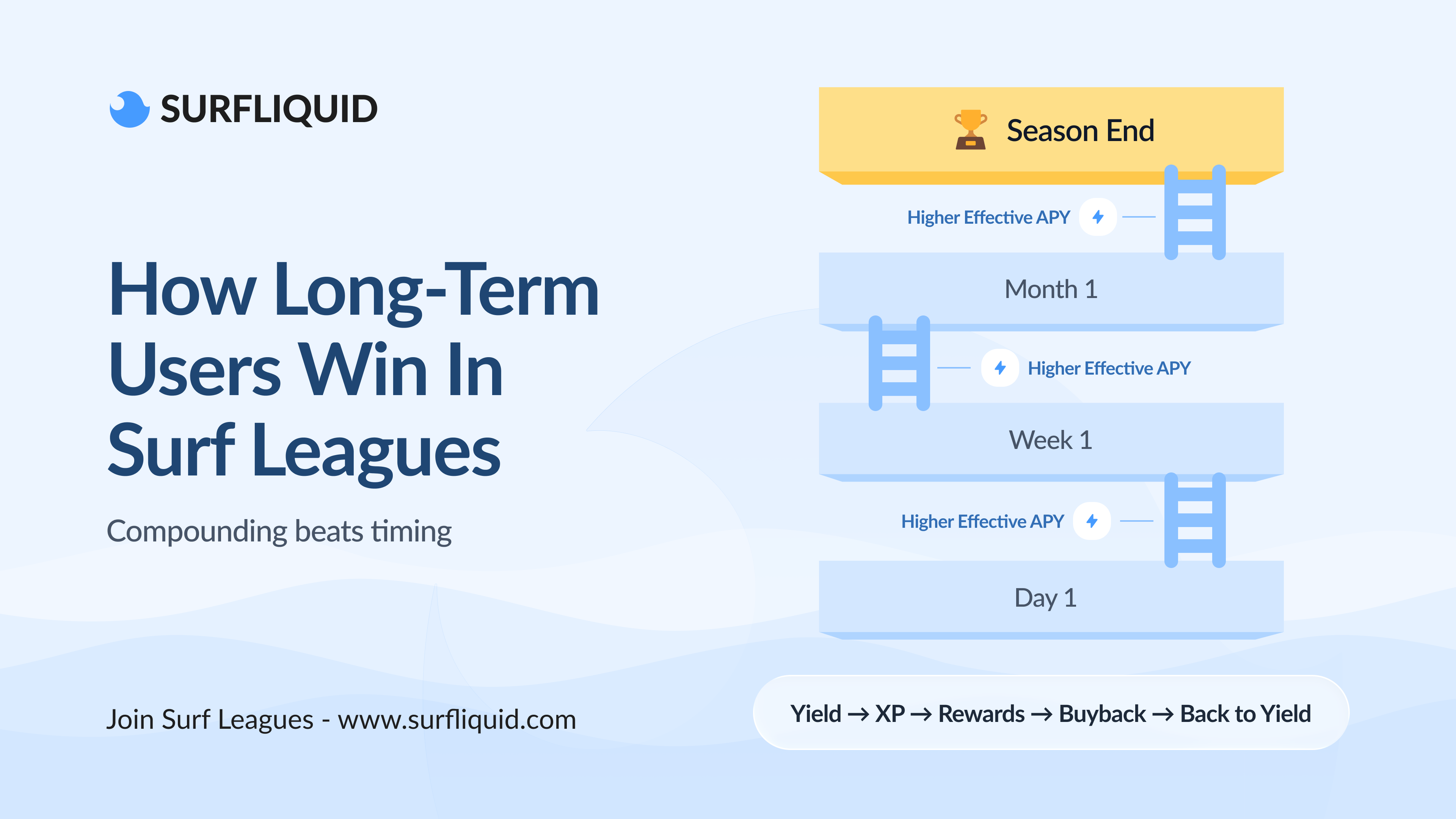
Long-term consistency across a full season increases effective XP weight.
* **Network multipliers**
Referral tree depth and sustained activity increase second-order XP flow.
* **Access tier multipliers**
Gated vaults and high-performance strategies carry higher XP velocity.
Multipliers reward behaviour that increases TVL stability, liquidity depth, and protocol resilience.
***
### **Treasury Flow**
Surf operates two coordinated treasuries:
#### 1. Protocol Treasury (Creator.Bid Safe Wallet)
Funded via:
* 2% of the 3% secondary market sell fee
* Used for:
* Core development
* Infrastructure
* Security
* Team operations
* Ecosystem growth
#### 2. Surf Treasury (Vault Performance Layer)
Funded via:
* 10% performance fee on realised yield
* Realised profits across active vaults
* Used for:
* Market buybacks of $SURF
* Strategic liquidity
* Long-term capital buffers
* Future incentive programs
Treasury flows are on-chain, auditable, and rule-governed.
***
### **Fee Routing**
Surf has two distinct fee streams:
#### Performance Fees (Vault Layer)
* 10% of realised profits across active vaults
* Used to:
* Buy back $SURF from the open market
* Accumulate protocol reserves
* Support long-term deflation and capital efficiency
#### Protocol Fees (Token Layer)
* 3% sell fee on secondary market trades
* 2% routed to the Surf Safe Treasury for operations
* 1% routed to [Creator.Bid](https://creator.bid) protocol for infrastructure sustainability
These fees are:
* Non-inflationary
* Non-custodial
* Automatically enforced by smart contracts
* Fully transparent and auditable
***
### **Reward Distribution Logic**
Season rewards are distributed based on:
> XP share = User XP ÷ Total Season XP
Final $SURF allocation per user is proportional to their contribution across:
* Capital deployed
* Time active
* Vault participation
* Network growth
* Long-term alignment via Flyover and staking
This creates a closed-loop system:
> Usage → XP → Rank → Rewards → Reinvestment → Higher Future Access
Not emissions farming. Not short-term extraction.\
**A compounding participation economy aligned with real on-chain value creation.**