> For the complete documentation index, see [llms.txt](https://surf-2.gitbook.io/surfliquid-docs/llms.txt). Markdown versions of documentation pages are available by appending `.md` to page URLs; this page is available as [Markdown](https://surf-2.gitbook.io/surfliquid-docs/infra-and-intelligence/execution-and-rebalancing-flow.md).
# Execution and Rebalancing Flow
#### Surf moves capital safely, deliberately and only when it is worth it.
Surf is not a system that constantly trades or churns funds. **It is designed to behave like a disciplined treasury operator**:
* Patient
* Risk-aware
* Cost-sensitive
* And fully controlled by deterministic rules
The system is designed to answer one question repeatedly:
**Is moving capital right now materially better than doing nothing, after risk, cost, and safety are considered?** Only if the answer is yes, execution is even allowed to begin.
This page explains how capital actually moves inside Surf.
***
### High-Level Flow
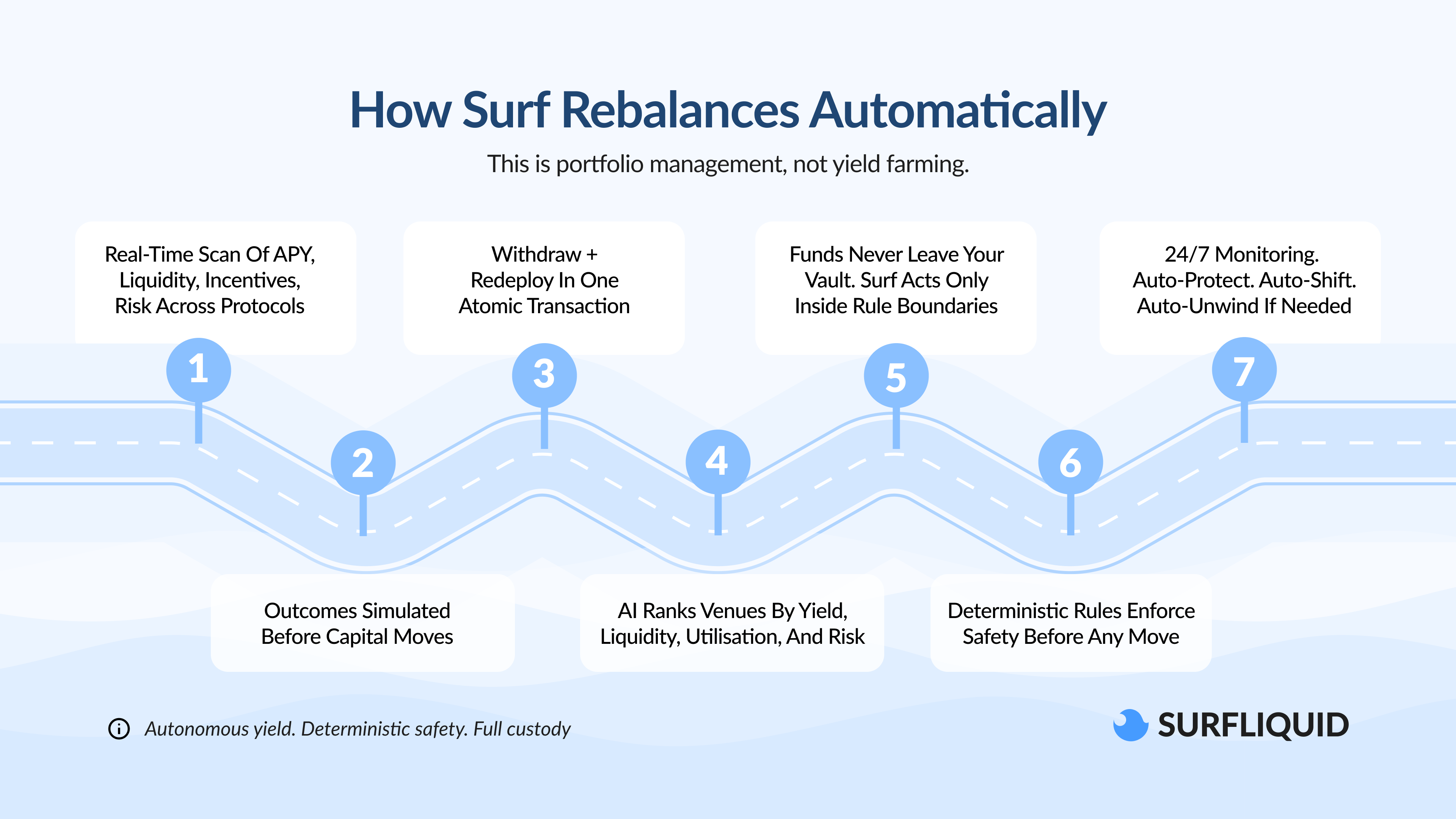
Every reallocation follows the same sequence:
1. Observe
2. Analyse
3. Simulate
4. Propose
5. Verify
6. Execute
7. Monitor
No step is skipped. No action bypasses control.
***
#### Step 1: Continuous State Monitoring
Surf continuously observes:
* Lending and liquidity venues
* Utilisation and borrow demand
* Incentive emissions and decay curves
* Liquidity depth and withdrawal capacity
* Volatility and correlation shifts
* Oracle deviations and price integrity
* Gas, slippage, and execution cost
* Cross-chain latency and bridge health
The data is aggregated across all allowlisted chains and venues. This creates a real-time state model of the opportunity and risk landscape.
***
### 2. Risk-Adjusted Analysis
Surf does not optimise for headline APY.
It scores opportunities based on:
* Net yield after gas, fees, and slippage
* Liquidity available for exit
* Protocol maturity and historical behaviour
* Correlation with existing positions
* Concentration impact
* Cross-chain execution complexity
**The result is a risk-adjusted return profile, not a raw rate comparison.**
***
### 3. Pre-Execution Simulation
Before proposing any move, Surf simulates:
* The full execution path
* All intermediate states
* Slippage impact
* Liquidity drawdown
* Post-move portfolio composition
* Updated exposure and concentration metrics
* Worst-case unwind scenarios
If the simulation shows marginal improvement or elevated risk, the move is discarded. **Most potential actions never reach execution.**
***
### 4. Proposal Generation
Only after passing the simulation does Surf generate a proposal:
* Which assets to move
* From which venues
* To which venues
* Through which routes
* In what size
* Under what timing assumptions
At this stage, nothing has moved. This is only a structured plan.
***
### 5. Guardian Layer Verification
The proposal is then evaluated by the Guardian Layer.
It enforces:
* Protocol allowlists
* Exposure caps per asset and venue
* Concentration limits
* Slippage bounds
* Liquidity exit thresholds
* Cross-chain routing constraints
* Portfolio health invariants
* Stress and anomaly checks
If any rule is violated:
* The action is rejected
* No funds move
* A rejection reason is logged
**This is what turns Surf from an optimiser into a constrained execution system.**
***
### 6. Deterministic Execution
If and only if all rules pass:
* Transactions are constructed
* Signed via MPC (Multi-Party Computation)
* Batched where possible
* Executed atomically when supported
Execution paths are predefined and auditable. There is no discretionary runtime behaviour.
**Funds never leave user custody. Surf only operates within pre-approved execution bounds.**
***
### 7. Post-Execution Monitoring
After execution:
* Portfolio health is re-evaluated
* Risk metrics are recalculated
* Drift from targets is measured
* Performance is recorded
* New baselines are established
The system returns to observation mode.
***
#### When Rebalancing Does Not Happen
Most of the time, the best action is no action.
Surf explicitly avoids:
* Chasing small yield deltas
* Over-optimising for short-term incentives
* Moving capital when costs exceed benefits
* Increasing risk to marginally improve APY
Rebalancing only occurs when:
* The expected improvement is meaningful
* Safety margins remain intact
* Exit liquidity is preserved
* Guardian constraints are fully satisfied
***
### Why This Matters
Traditional yield optimisers focus on rate chasing. **Surf focuses on controlled state transitions.**
This is the difference between:
* “Where is the highest APY right now?”
and
* “Is it safe and worth changing the entire system state to get it?”
Execution is not about being fast. It is about being correct, verifiable, and reversible.
**This flow is intentionally conservative.**
Surf optimises for:
* Capital preservation first
* Predictable behaviour
* Long-term compounding
* And user trust
Not for:
* Maximum short-term yield
* High turnover
* Or speculative positioning
***
### Key Properties
* Surf never touches funds directly
* All moves are simulated before being proposed
* All proposals are rule-checked before execution
* All executions are deterministic and auditable
* All outcomes are continuously monitored
***
### In Simple Terms
Surf behaves like this:
> “Only move money when the benefit is clear, the risk is bounded, and the rules allow it.”
**That is how automation becomes safe for on-chain savings. That is the execution standard Surf is built on.**